on
Applying the Corrective Lens to Surah Al-Ikhlas
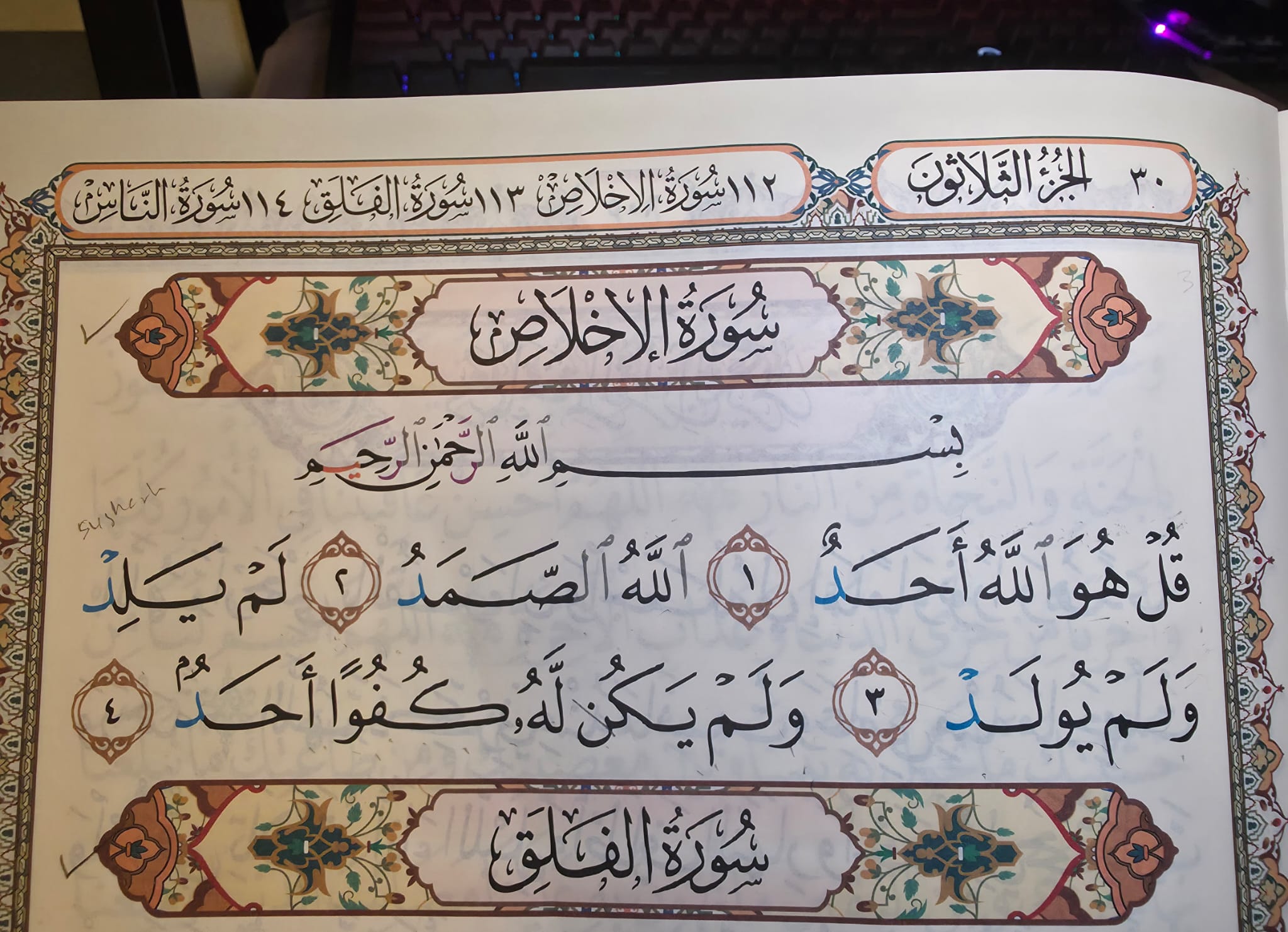
Note: This reading approaches the surah with due respect while applying a structural, linguistic corrective lens. It is not tafsir, but an examination of how meaning shifts across Arabic, Malay, and English.
In the previous essay, “Discovering Through the Correct Lens of Languages”, I argued that language is not merely a tool for translation. It is a corrective instrument.
When you triangulate between Arabic, English, and Malay, you are not collecting synonyms. You are refining boundaries. Each language exposes distortions the others quietly introduce.
Surah Al-Ikhlas is a test case. Four verses. Extreme brevity. Maximum density.
Without precision, the surah sounds simple. With precision, it becomes structurally absolute.
Verse 1
Qul huwa Allahu ahad
قُلْ هُوَ ٱللَّهُ أَحَدٌ
“Say, He is Allah, One.”
In English, “One” is easily heard as numerical. It suggests counting. One among others. A unit inside a larger set.
In Malay, “Esa” signals uniqueness. But it can still drift toward superlative logic. The greatest. The highest. The ultimate instance.
The Arabic ahad is tighter than both.
It does not merely affirm singularity. It denies comparability within any shared category.
If something is numerically one, it still belongs to a class that could contain more. “Ahad” blocks that logic. It is not arithmetic. It is categorical negation.
Allah is not one being among many beings.
- He is not the highest member in a hierarchy.
- He is not a supreme instance of a broader genus.
- He is not inside the set at all.
Verse 2
Allahu as-samad
ٱللَّهُ ٱلصَّمَدُ
“Allah, the Eternal Refuge.”
English emphasizes refuge. Malay emphasizes dependence. Both are helpful. Neither is complete.
As-samad refers to the One who is absolutely self-sufficient and the One upon whom all else depends.
This is asymmetry without reciprocity.
Everything within creation is contingent. Every system requires sustaining conditions or prior causes. Even self-regulating systems rely on laws they did not author.
As-samad names the only non-contingent reality.
This is not devotional exaggeration. It is structural description.
Verse 3
Lam yalid wa lam yulad
لَمْ يَلِدْ وَلَمْ يُولَدْ
“He neither begets nor is born.”
In English and Malay, this is often heard biologically. The Arabic construction goes further.
Lam yalid denies outgoing generation. Wa lam yulad denies incoming origin.
The verse closes both directions of dependence.
To be born is to have a starting point. To beget is to extend oneself forward in succession. Both assume temporality. Both assume placement within a chain.
Finite systems inherit and project. They occupy positions in time.
This verse removes the Divine from temporal sequence altogether.
- No prior state.
- No derivative continuation.
- No lineage backward.
- No lineage forward.
Verse 4
Wa lam yakun lahu kufuwan ahad
وَلَمْ يَكُن لَّهُۥ كُفُوًا أَحَدٌ
“And there is none comparable to Him.”
The key term is kufuwan.
Equivalence implies shared structure. If two things are equivalent, they belong to the same type. They are comparable instances within a broader class.
This verse denies that possibility.
- No peer class.
- No parallel instance.
- No scalable comparison.
The Creator is not a maximized version of creation. Not an infinite instance of a finite pattern. Not the upper bound of a continuum.
The comparison framework itself collapses.
Closing the Structure
Surah Al-Ikhlas does not elaborate. It delineates.
Each term functions as a boundary condition:
- Ahad denies shared category.
- As-samad denies dependency.
- Lam yalid wa lam yulad denies temporal succession.
- Kufuwan ahad denies equivalence.
Together, they eliminate four recurring distortions:
- Numerical reduction.
- Contingent projection.
- Temporal embedding.
- Comparative scaling.
The text does not change.
The lens does.
And once the lens is corrected, the mind can no longer quietly import creaturely logic into the Absolute.